
One closure intelligence engine, adapted to each site
Every site asks different questions and starts from different evidence. AuraMine keeps the same approach to evidence, liability ranges, financial modelling, community outcomes and decision records, and adapts the method to the site in front of it.
Reduce the closure liability you carry forward
While a mine is operating, choices made now shape both closure cost and the community's transition beyond mining. AuraMine helps closure and finance teams test pathways early, understand whole-life cost and consider local livelihoods, access and future land use as the mine plan changes.
- Compare progressive rehabilitation and closure pathways
- See the cost of deferring intervention
- Keep closure cost ranges and assumptions up to date
- Connect closure planning with financial planning
- Consider workforce transition, local livelihoods and community priorities
Cost across the life of the site
IllustrativeProgressive rehabilitation
Deferred to closure
Timing is part of the estimate. Acting earlier changes what the same closure plan ends up costing.
Understand the obligation, and the opportunity
Legacy sites often have no operator and no production income, but still carry mine-water, contamination and long-term care obligations. Communities live alongside these sites and hold knowledge that historic records may miss. AuraMine builds a confidence-rated baseline, estimates whole-life cost and screens future uses alongside local priorities, access and public value.
- Confidence-rated baseline from historic records
- Upfront works and long-term stewardship costed separately
- Remediation and land-use scenarios compared together
- Clear priorities for further investigation
- Bring local knowledge and socioeconomic priorities into land-use comparisons
Evidence, rated as it arrives
Illustrative- Archive planHistoric
- Aerial surveyOlder
- Site walkoverRecent
- Ground investigationOngoing
Upfront works and long-term care are costed separately, then brought together as one whole-life obligation.
| Aspect | Active mine closure | Legacy sites |
|---|---|---|
| Main question | How to reduce future closure liability | How much to spend now to make the site safe, and what long-term obligation remains |
| Evidence | Current plans, surveys and monitoring | Historic, incomplete and scattered records |
| Main uncertainty | Future mine footprint and timing | What is actually there, its condition and what was done before |
| Delivery | Existing equipment and workforce on site | Standalone contractor works, often through public procurement |
| Success | Achieving closure and handing back the land | Reduced harm, proportionate spending, credible long-term stewardship and public value |
| Community priorities | Plan for workforce and local economic transition, with dialogue before operations end | Understand ongoing impacts, rebuild dialogue and consider access, heritage and local opportunity |
That is why AuraMine does not simply reuse operating-mine cost templates on legacy sites. The method adapts to the evidence available.
Shared evidence model
Every input recorded with its source, date, confidence and owner.
Whole-life financial modelling
Cost ranges, year-by-year profiles and present values, using the client's appraisal approach.
Scenario comparison
Pathways compared on cost, residual risk, environmental performance and socioeconomic outcomes.
Decision record
Named owners, rationale and review status, including how community evidence is considered.
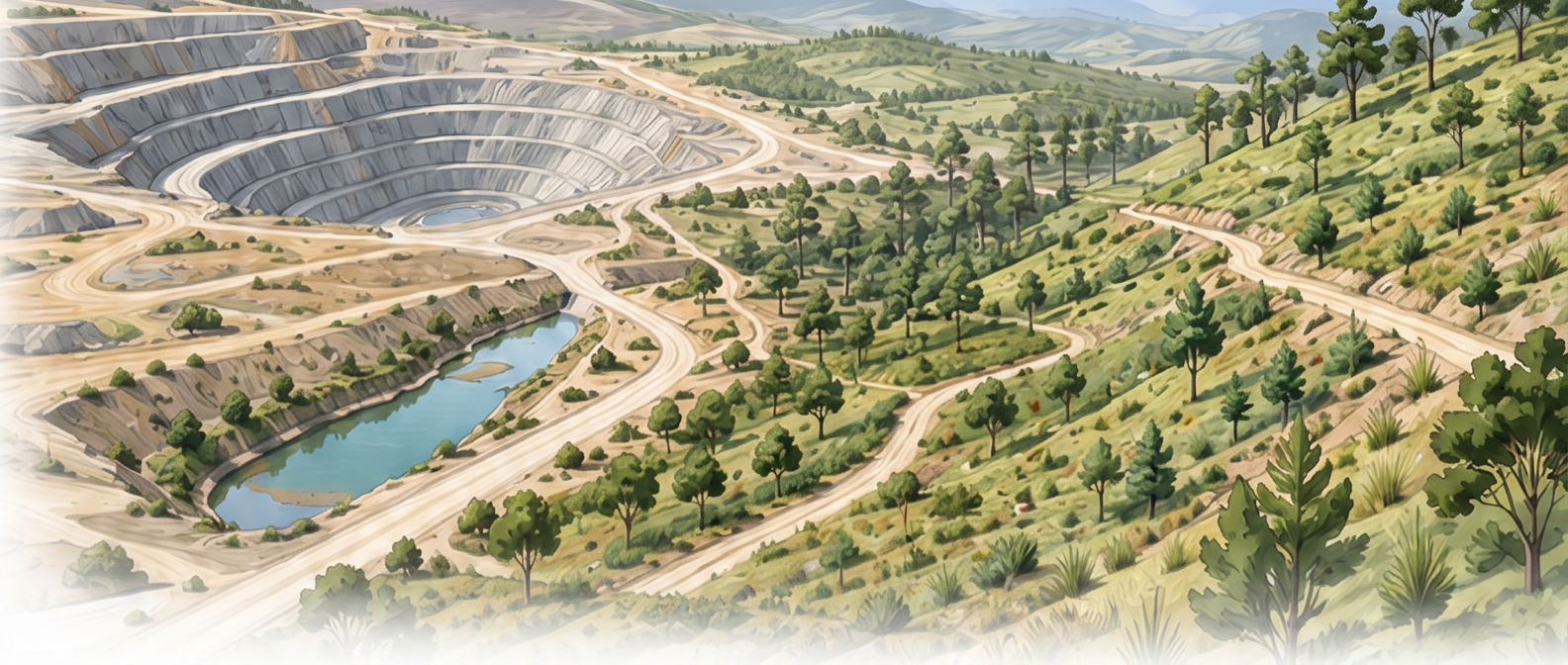
Considering what a site could become, from the start
Remediation and future land use are better considered together than in sequence. Depending on the site, credible options can include renewable energy, mine-water heat, nature recovery, recreation, heritage or regeneration. AuraMine screens them alongside the remediation they depend on, and always shows their value separately from the cost of making the site safe.
Local priorities matter: who can access the land, which livelihoods a new use could support, and how benefits and burdens are shared. These are questions to explore with communities, not assume on their behalf.
- Renewable energy
- Mine-water heat
- Nature recovery
- Recreation
- Heritage
- Regeneration
Local experience belongs in the evidence base
Our planned community-facing platform will let people follow site progress and timelines, raise concerns and see responses. Reviewed feedback will connect to the site analysis rather than sit in a separate engagement report.
- 1
Share
Site teams publish accessible updates and monitoring context.
- 2
Listen
Communities share concerns, local knowledge and future-use priorities.
- 3
Review & respond
Named reviewers consider the evidence, inform analysis and record a response.
Mine operators and closure teams
Test closure pathways early and keep estimates current as the mine plan changes.
Public bodies and regulators
See liabilities, priorities and long-term obligations in one evidence-based picture.
Asset managers and long-term stewards
Bring closure costs, risks and future value into your own financial models.
Consultants and specialist reviewers
Work from a shared, confidence-rated evidence base with a clear audit trail.
Have a closure decision at an active or legacy site?
We’re working with a small number of design partners, each on a real site decision.